Menu




Renting a home does not mean you forfeit your basic right to safety. In Alaska, landlords must use reasonable care to maintain their premises in a safe and habitable condition. When they do not, landlord liability may be incurred. A tenant who sustained serious injuries due to icy stairs, broken railings, mold, or other hazards may be entitled to compensation for the harm they suffered.
Slip-and-fall and trip-and-fall accidents can happen almost anywhere and can cause serious injuries. In Alaska, if a landlord knew, or should have known, about the hazard that caused a tenant’s injuries, they can be held liable and required to pay medical bills and other damages.
Under Alaska law, a landlord has a legal duty to ensure every part of the premises a tenant is renting is safe for people to live in. This was not always the case. In Newton v. Magill (1994), the Alaska Supreme Court ruled that a landlord must exercise reasonable care to ensure leased premises are safe. In that case, the plaintiff was injured when she slipped and fell on a wooden walkway on a property she was renting. Ruling in favor of the injured plaintiff, the court overturned the prior common-law rule that “real property lessors are not liable to their tenants for injuries caused by dangerous conditions on the property,” noting that this outdated concept was based on the idea that, under a lease, the tenant becomes the owner of the property for the duration of the lease agreement.
In Newton, the court noted that “The courts of a number of jurisdictions have begun to discard this common-law rule in favor of the principle that landlords are liable for injuries caused by their failure to exercise reasonable care to discover or remedy dangerous conditions. These courts have relied in part on statutory or common law warranties of habitability and in part on a belief that the rule of landlord immunity is inconsistent with modern needs and conditions.” The court did not limit its decision to common areas and extended its ruling to accidents that occur in areas occupied solely by the tenant, which must also be evaluated under a “customary negligence analysis” when an accident occurs that causes injuries.
Landlords have traditionally been responsible for maintaining common areas, such as hallways, stairwells, parking lots, and laundry rooms. In Alaska, that duty extends to a tenant’s private unit if the landlord knew or should have known of the hazard and failed to address it.
In Newton, the court noted that, unlike other jurisdictions, which determine the duty a landlord owes based on classification of the person seeking compensation as a trespasser, licensee, or invitee, Alaska “adopted a rule based on general tort law that an owner ‘must act as a reasonable person in maintaining his property in a reasonably safe condition in view of all the circumstances, including the likelihood of injury to others, the seriousness of the injury, and the burden on the respective parties of avoiding the risk.’"
The court went on to emphasize that, under AS 34.03.100(a)(1), landlords “‘have a continuing duty to ‘make all repairs and do whatever is necessary to put and keep the premises in a fit and habitable condition’” and that their “duty is to use reasonable care to discover and remedy conditions which present an unreasonable risk of harm under the circumstances. Nor does our ruling mean that questions as to whether a dangerous condition existed in an area occupied solely by the tenant or in a common area, or whether the condition was apparent or hidden, are irrelevant.”
Alaska applies a “customary negligence analysis” in cases involving injuries to a tenant. This means an injured person must prove four factors to succeed in a claim for damages.
The factors that must be shown to establish landlord liability include:
A landlord must use reasonable care to maintain the premises in a safe and habitable condition. Their duty of care is what a reasonable person would do in the same or similar circumstances.
Breach of duty occurs when the landlord fails to exercise ordinary care by allowing a hazardous condition that they knew or should have known about to exist on the property.
Causation means the landlord’s failure to use ordinary care caused the plaintiff’s injuries. This is sometimes referred to as “but for” causation, meaning that the plaintiff would not have been injured “but for” the landlord’s negligence. The plaintiff’s injuries must have been reasonably foreseeable, and the defendant’s actions must have been sufficiently related to the plaintiff’s injuries to assign legal liability.
Finally, the injured person must establish the measure of their damages, which represents the amount of harm the defendant caused. Damages often include economic losses, such as medical bills, lost income, and property damage, as well as non-economic losses like pain and suffering, loss of enjoyment of life, and emotional trauma.
In Alaska, the statute of limitations for most personal injury claims is two years, including those involving landlord liability. This means the injured person has two years from the date of injury in which to file a lawsuit seeking compensation for their losses. Nonetheless, you should contact a personal injury attorney as soon as possible. If you wait, evidence may be lost or destroyed, witnesses may move away or die, or memories may fade.
The steps you take in the moments after an accident that causes serious injuries can shape your claim for damages. If you are injured as a tenant, be sure to do the following to build a strong personal injury claim:
When an accident causes serious injuries, an Alaska personal injury attorney can shoulder some of the burden so you can focus on your recovery and regaining your health. Alaska personal injury attorney Eric Derleth can investigate and gather evidence to prove your claim, communicate with your landlord’s insurance company, guide you through the insurance claims process, and protect your rights to help you recover the full compensation you deserve.
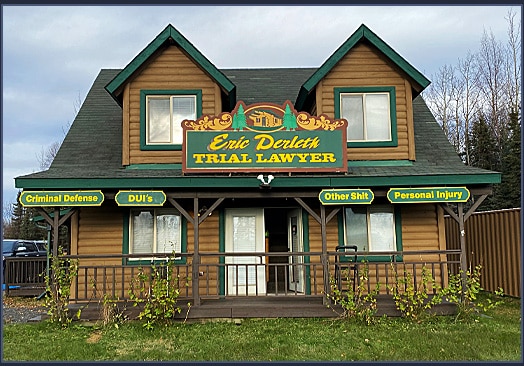
Eric Derleth, The Trial Guy, is pleased to provide reliable legal representation for clients facing a wide range of personal injury matters. He proudly serves clients in Anchorage, Soldotna, Kenai, Palmer, Fairbanks, Juneau, Wasilla, and other areas of Alaska. Call 907-262-9164 to schedule a free consultation at our Anchorage or Soldotna office, or contact us online. Our phone lines are open 24 hours a day, seven days a week.
© 2026 Eric Derleth - Trial Lawyer, Inc.|Legal Disclaimer|Privacy Policy