Menu




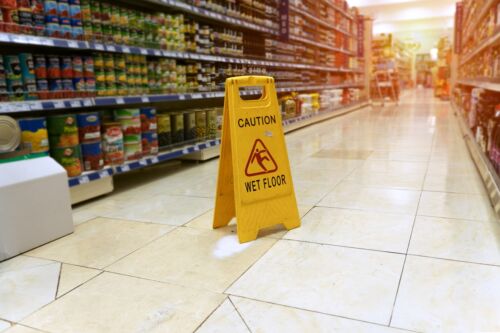
While most trips to the grocery store are uneventful, slip and fall accidents do happen from time to time. If you slipped on liquid, debris, or another substance while food shopping and were hurt, you might be wondering, “is the grocery store responsible if I slip and fall?” The answer to this question is highly fact specific. Importantly, if a grocery store’s employees or management failed to properly maintain the premises and you were injured as a result, the store may be held liable for your damages.
A grocery store can be held liable for injuries incurred in a slip and fall accident if it had actual notice or constructive notice of a hazardous condition. In other words, a grocery store can be held liable for a slip and fall accident if an employee, supervisor, or manager knew (or should have known) about a spill, debris, or other substance on the floor and failed to clean it up within a reasonable amount of time. Notably, a grocery store has a duty to conduct reasonable inspections of the premises. Failure to reasonably inspect the aisles and surrounding areas during open hours may result in a finding that the store had constructive notice of a dangerous condition that caused a patron to slip and fall.
A grocery store can also be held liable for failure to warn about a dangerous condition. For example, if a floor was recently mopped, the store has a duty to warn customers and other employees that the floor is wet by placing a warning sign, roping the area off, or otherwise restricting access to the area.
Additionally, liability may be incurred in some situations in a grocery store’s parking lot. Unplowed snow or black ice that has not been removed can create dangerous conditions that increase the risk of slip and fall accidents. Depending upon the facts and who owned the lot, a grocery store may be responsible for failure to properly maintain the lot, remove known hazards, or warn customers about dangerous conditions.
Not every slip and fall at the grocery store is caused by negligence. However, grocery stores have a responsibility to keep the premises reasonably maintained and timely address any hazards that could lead to an injury. Liability for a slip and fall is much more likely to be incurred for a slip on a rain puddle in the entryway that was left unmopped for a few hours rather than a milk spill that occurred just a few minutes prior.
Some common causes of grocery store slip and falls can include the following:
After a slip and fall at the grocery store, it's crucial to document the scene, report the incident to management, and seek prompt medical attention. Even if you don’t think you’ve been badly hurt, some injuries take weeks to develop. By getting the immediate medical help you need, you can not only protect your health, but safeguard your legal rights and strengthen any personal injury claim you may file.
A grocery store slip and fall can lead to broken bones, fractures, soft tissue injuries, concussion, nerve damage, and even paralysis in severe cases. These types of injuries can result in significant medical expenses and cause you to lose time from work while you recover. Depending on the extent of your injuries, you may also require ongoing physical therapy, surgery, and long-term rehabilitation. By filing a personal injury action, you can hold the store accountable for the impact its negligence had on your life and livelihood.
If a slip and fall at the grocery store was the result of the store’s negligence, you may be entitled to recover both the economic and non-economic damages you suffered. Economic damages are meant to compensate for things like your medical expenses, lost wages, out-of-pocket costs, and other pecuniary losses in connection with the accident-related injuries. Non-economic damages (also referred to as “pain and suffering”) cover the losses that are much more difficult to quantify, such as loss of enjoyment of life, emotional distress, embarrassment, disfigurement, and loss of consortium.
If you sustained injuries in a slip and fall at the grocery store, it’s essential to have an experienced personal injury attorney who can assist you with navigating the legal process and secure your rightful compensation. Proudly serving accident victims in Anchorage, Soldotna, Kenai, Palmer, Fairbanks, Juneau, Wasilla, and other areas of Alaska, The Trial Guy, Eric Derleth, provides trusted representation for clients facing a wide range of personal injury matters, including slip and fall accidents. Call 907-262-9164 to schedule a free consultation at our Anchorage or Soldotna office, or contact us online. Our phone lines are open 24 hours a day, seven days a week.
© 2026 Eric Derleth - Trial Lawyer, Inc.|Legal Disclaimer|Privacy Policy